

My Creator Toolkit
Every tool I rely on, what I use AI for (and what I won't), and why human taste, personality, and discernment will always reign supreme.

Today’s post is a little different from usual; it’s a bit inside baseball. I know that I have a lot of creators (and aspiring creators, hi!) following me. I’ve talked a lot about how much time I spend looking at data, as well as some of the other tools I use. Whenever I mention any of this, I get asked, “Please! Write a post about this!” Buckle up: this post is a long one. And there is no paywall.
I am so proud of the business I’ve built. I have been doing this for 16 years and have a very clear vision of my brand, what my audience likes, and what they don’t like. It’s been a big year of changes. My business has grown tremendously with the addition of Substack. In 2025, I ranked in ShopMy’s top 5 creators and in the top 10 fashion and beauty Substacks. That number is based on paid subscribers, not total subscribers, but it’s still pretty cool. After reading Emma Grede’s book, I’m resisting the urge to say something self-deprecating.
We put out a lot of content (4-5 blog posts, 4-5 newsletter sends, 4-5 grid posts, + Instagram stories) each week. I’m also balancing other things: writing a book, building an app, a couple product collabs. Something has to give. You cannot do everything, but I’ll always try. Doing this means following the very overused but always true advice: work smarter, not harder.
Today, I’m sharing the tools I rely on. I want to add: I am not a tech whiz. I have determination and grit, but it can take me a little while to catch on. I am lucky to have a few friends who have helped me (shout-out to my friend Holley’s husband, Bobby — he spent two hours painfully teaching me Claude Cowork!), but this is not my skill set. If I can do these things, you can, too.
ShopMy
ShopMy is one of the key ways I monetize my content, but it’s also an important tool. In March, I experimented: I started putting every single link in a hidden collection. Every link we posted was classified. Each individual blog and Substack post, plus a general one for stories, broadcast channel, Substack chat, and DMs. Why? Because I felt overwhelmed by how much work I had, and wanted to figure out, on a very granular level, what was moving the needle and what wasn’t.
This took time and energy, but it was worth the extra effort. Once we had a full month of clean data, I exported it from ShopMy. I’ll tell you exactly what I do with that data, down below.
Sidebar: I get asked all the time why I use ShopMy vs. LTK, and it’s just a personal preference. I joined it because a handful of brands I worked with asked me to, and I stayed because I like the team and their data-driven approach. (I really love my rep Erin; she is a fellow data nerd and has been instrumental in helping me grow my revenue.)
Coreli
I am extremely impressed with what Thomas and Chloé are building with Coreli. They’ve been in the industry as long as I have (maybe even longer?), so they have a really good handle on what works and what doesn’t, and what creators actually want. Thomas has been working side by side with Julia for years, and Chloé has worked with hundreds of the top creators on the technical side of their businesses. They create tools for anyone who uses content to build their business (and honestly, that is everyone these days!).
Coreli currently has two tools (but shhh, more are rolling out!). The first is their link-in-bio tool. It pulls in your Instagram content and builds a landing page around it. I was one of their first users and was able to easily set mine up in about thirty minutes. What I like about it is that it automatically keeps up with your latest content (I get busy and forget to update these things!). You can customize it with drag-and-drop sections and add your own links and images to feature exactly what you want.
Looks good, easy to set up, self-updating = my ideal tool. Now, when someone visits the link in my bio, they can get a good idea of everything I do. It’s a home for my blog, my Substack, my Instagram – even my ShopMy links (You can set it up to use your LTK links as well). It’s great for everyone, not just creators: founders, small business owners, anyone with a personal brand.
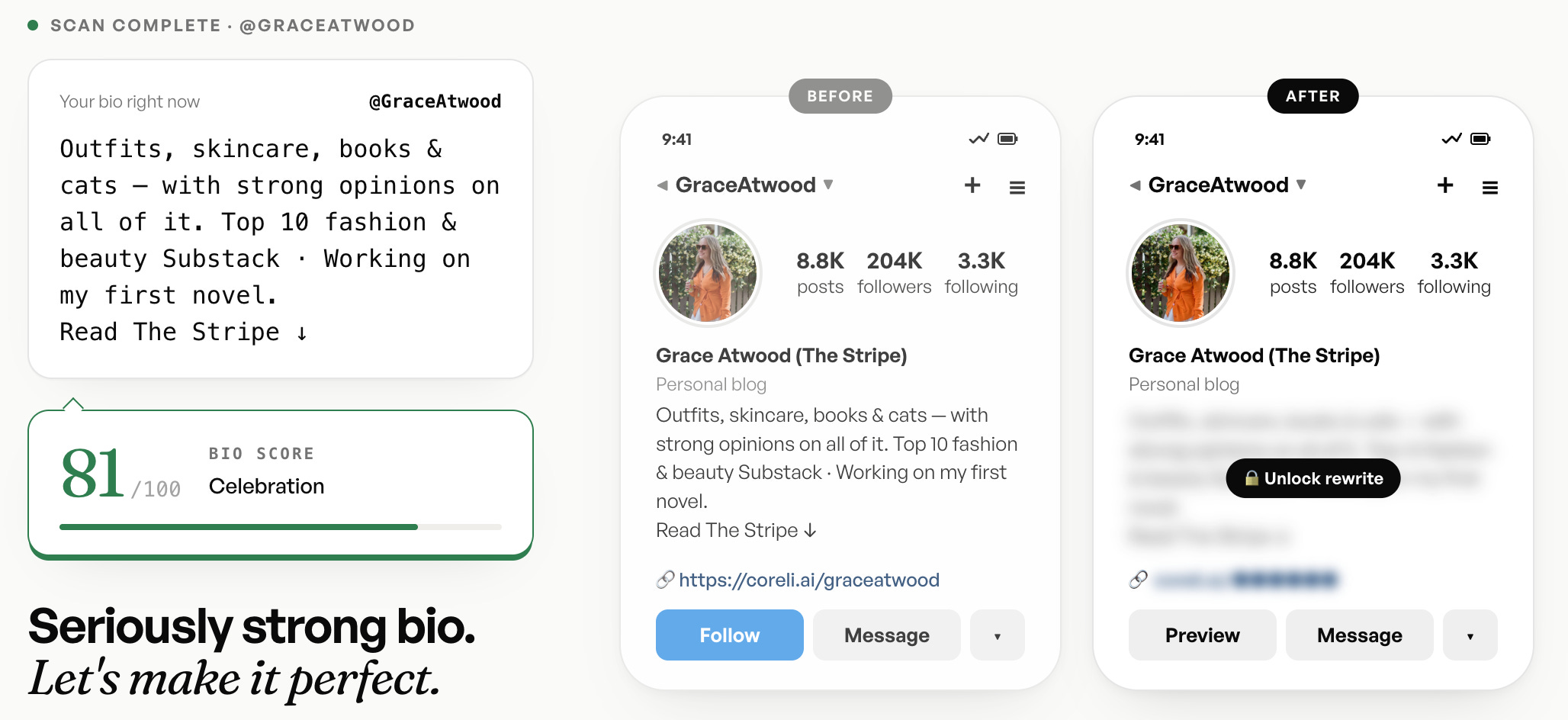
Coreli’s second tool launched this week: an Instagram bio analyzer. Drop in your handle, and it will scan your bio + captions and use best practices to rewrite your bio. I used it and was impressed!
Lastly, the Coreli blog. This is a goldmine for educational content. Thomas put together this guide to affiliate linking/a ShopMy Masterclass of sorts, and it is the best I’ve ever seen. I sent it to several of my creator friends with the note: “Read this now!!” I am always so impressed when other creators are generous with their learnings and strive to do the same.
Claude
Before we talk about AI, I get it, it’s polarizing. I use it pretty sparingly. I want to be mindful of the environment, and I don’t want to rot my brain or impede my ability to think critically. That scares me!
I think when you mention using AI, people automatically assume that it is for writing. I want to state upfront that I do not use generative AI to write. For my blog, my newsletter, and (I hope this is obvious as it’s highly unethical), my upcoming book. Writing is the part of my job I enjoy the most, the thing I want to improve upon! My goal is to simplify other parts of my business with AI so that I have more time to write.
I am of the mindset that you shouldn’t use AI for the thing you want to call yourself (writer!) or improve upon. So using AI to write is off the table for me. I have no interest in learning how to make pivot tables and charts so I’m all in on having it analyze my data. I am not a jewelry designer, but for an upcoming collab, I used it to help me make renderings to communicate my ideas to the brand. So helpful! The team understood my vision exactly and the brand’s designer is using my rough AI renderings to make real designs.
Let’s talk about Claude + ShopMy because that’s where AI has been most helpful.
Claude has been beyond helpful as an analyst for my affiliate data. The value I have gotten from it is well worth the $20/month fee.
I take that ShopMy data that I referenced earlier, and I have Claude clean it up. This is the prompt I use:
“I have uploaded my XYZ month ShopMy Data. You will see all of my ShopMy data. It is messy, it is in comma-delineated format, and some of the data values have commas in them. We need to clean this up and create a new clean file that we can then analyze.”
(This is now saved as a skill so Claude automatically knows what to do.)
“/analyze new cleaned file. Tell me the biggest takeaways. I’d like a recap of which posts performed best, best-selling products, top brands. Please look at collections and break down performance across channels (Instagram, Blog, Substack, Shelves, Grid Posts). Please include one full page of strategic insights. I’d love advice on what to post more of (or less of!), along with bigger picture strategy. Then, I want you to create me dashboard using /build-dashboard”
I had to go back and forth with it several times, telling it what I liked and didn’t like, but that’s easy: talk to it like it’s your intern. I was even able to get it to use my brand colors, which sparks great joy for me — I like everything to be pretty.
(The dashboard is also saved as a skill, so all that back & forth was a one-and-done.)
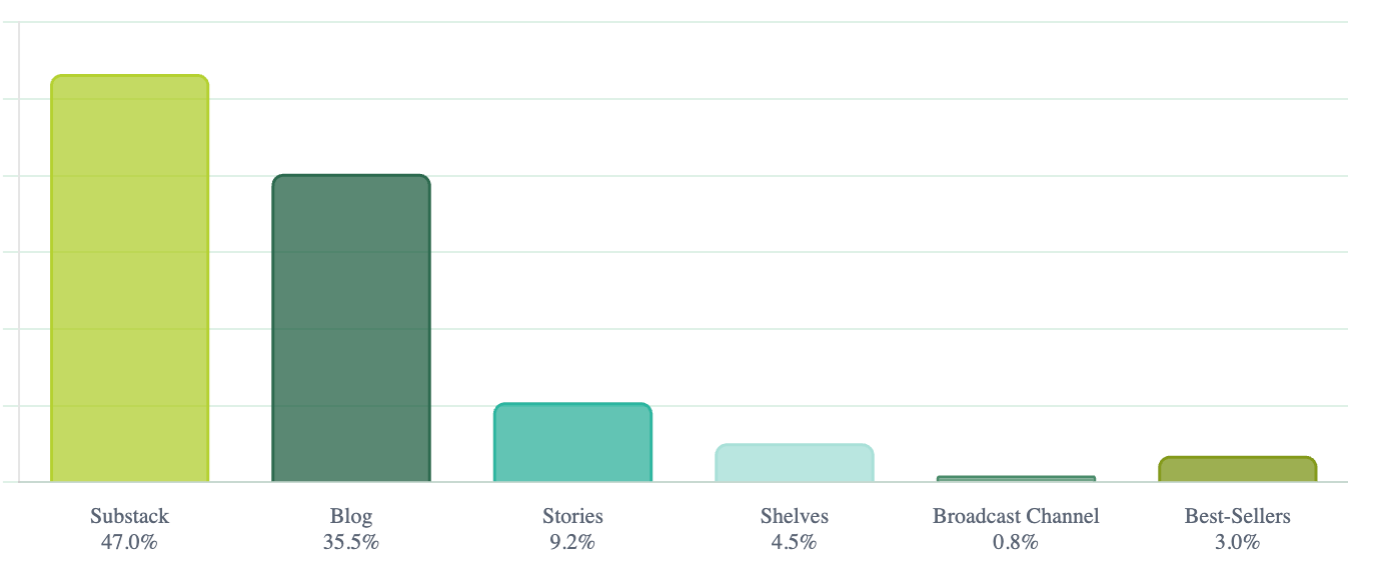
The biggest learning is up at the top. Seeing that 47% of my revenue came from Substack and 35% came from the blog? Holy shit. It definitely took the pressure off constantly being plugged into Instagram. I suppose I could look at it as an opportunity to do more on Instagram, but I don’t. I’d rather focus on the channels that are performing well (besides, I’m a long-form girly).
I had Claude look specifically at tracking exact revenue by post. It was pretty jarring. The trend roundups Carly and I were working so hard on? Barely any sales (relative to other content). Lists, like Weekend Reading? Off the charts. My blog’s weekend reading series continues to outperform everything else. As a result, we scrapped the trend roundups and added another list (meet The Wednesday Ten, which is honestly far more enjoyable for me to create).
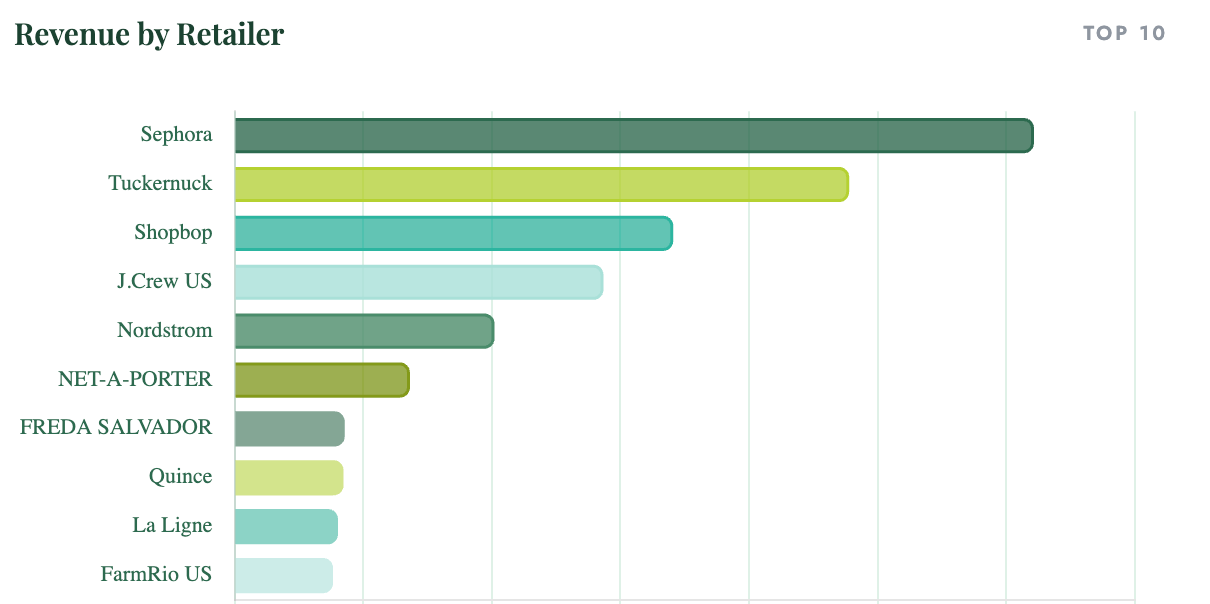
We obviously look at revenue by retailer and individual best-selling items. Earnings-per-click (both at the retailer and item levels) is another really important metric to ensure our linking is as efficient as possible. My monthly dashboard is six pages long; these are just a couple screenshots, but this data is invaluable.
I’m not completely ruthless: not every post is meant to make money (my wish lists are often too expensive and/or the products are from small businesses that don’t pay commission, my Friday newsletters and more personal pieces like this barely contain any links), but information is power.
I will add that I ask it for strategic insights, and 70% of the time, they are, at best, obvious, at worst, hilariously bad. When I picture Claude as a human (sorry, I anthropomorphize everything), he is a white guy in his late fifties who has never read a fashion blog. He’s wearing a polyester suit and ill-fitting khakis. He’s literally the person saying, “You can make money doing that???” Long after the Sephora sale has ended, he’s telling me to post more Sephora links. He’s telling me to replicate the Saturday Group Text format for all of my posts. He has no context or experience, but he’s cheap and great at data analysis, so we keep him around. He can pull the data and make us pretty charts, and I’ll take it from there.
Humans
There is not a person I work with whose job will ever be at risk (so long as I can still afford them) because of AI. It is a tool that helps us work more efficiently. It is not (and will never be) a replacement for human taste, discernment, or judgment. Or personality! While I believe it’s important that we learn how to use AI, honing our taste and judgment is way more important — especially as the landscape changes.
As a creator, your taste, your personality, and your recommendations are what will set you apart. My recommendations (and testing out new things to report back) are what I work the hardest on, aside from writing + creating the actual content (photos and videos). Every single thing you see on my channels is thoroughly vetted by me (and now Carly) — often for weeks, if not months. That takes a lot of work.
I am more reliant on humans than anything else. I realize that not everyone is in a position to hire a team: I’ve been at this for a while. For every role I’ve hired for, I've done their job at one point. I used to negotiate my brand deals, make all my blog graphics, edit my photos and videos, etc. But back then there was no Substack and no DMs or Instagram stories. It was just my blog and my grid (then, a single photo!). Posting once a day to each of those was completely manageable. As the workload changed and my audience grew, I needed help. My method here has been to work really hard and hire, hire, hire as I grow. It’s hard to grow without the right support system.
My head of partnerships, Kristin, always has my back and is the queen of a tricky email, said in the loveliest way possible. I can’t imagine trying to outsource her job to AI. All that correspondence with brands requires a firmness (and grace) that comes from hiring the right person. Carly is basically my right arm (seriously, I’ve never let myself trust anyone this much, it’s terrifying but also amazing) and has exceptional taste and a killer eye. I’d much rather she spend a few hours every day searching the web for cool new brands and designers to feature than slogging through Excel to make me a dashboard. My graphic designer knows my brand inside and out. I’ve played with the Claude + Canva tool, and while it’s interesting, it doesn’t do what I need. Human taste > > > robots.
My human editor. This is a love letter to Mary Logan. She challenges me to think harder, rearrange my words, expand on certain points, and cut back on others. (She did not edit this piece, which is probably why it’s so long and likely riddled with typos). In a pinch, I’ve had AI provide edits on my Substack (I ask it for a list of edits, not a rewritten piece). It is great for pointing out where you repeat yourself, where you’re being long-winded, and cleaning up grammar and typos. But it’s not even 1/10th as helpful as having a human being edit your work. (Again, taste! But also, expertise and over a decade of experience). I’ve worked with her for over a year and have learned so much and become a stronger writer from our time together. AI could never.
A few other things in my toolbox:
I have been using Planoly to plan my grid and stories for years now. I plan my grid less now, but the biggest thing for me is using it as an easy way to save future Instagram stories and prep them for posting. Once or twice a day, I go in and add everything from my graphic designer (along with links), so that it’s all there waiting for me.
I was a Photoshop purist for so long, but Canva is just so easy. I will use it to make quickie last-minute graphics for my blog or Substack when I’m in a pinch.
This is what I use to send my blog’s daily emails. We used to use Mailchimp, but it got really expensive as our list grew, and I realized we could use a simpler, less expensive tool and get the same results.
Email is my number one focus (it’s why I first joined Substack!). Back in my BaubleBar days, I saw that email was always our top sales driver (way ahead of social) and sought to replicate that as best I could with my newsletter. My newsletter is now my Substack, but we also send daily blog posts, as you can’t expect people to remember your website.
This is what I use to create an autoresponse on Instagram. When you see “comment to get a link,” that’s not me individually sending you the link. This has been such a good addition, mostly because stories expire, and reels can have a longer shelf life — I’ll get comments on something months after I post it, and I don’t always see them.
I think that is everything. I hope it was helpful!
Xo!
This is a very generous post for aspiring content creators. I am not one of those, however, I read the entire email because I was fascinated about how much work goes into it. Thanks for the look behind the curtain.
This was so insightful. Your transparency and standard of excellence are really 2nd to none in this realm! You’ve made me want to learn things I didn’t even know I *could* learn. Xx